
MAI-Transcribe-2 vs Muse Voice Transcribe: 10s Files vs Live Speakers (2026)
Microsoft MAI-Transcribe-2 finishes an hour of audio in about 10 seconds. Meta Muse Voice Transcribe labels 20+ live speakers. Here is which job each model actually wins in 2026.
Microsoft shipped MAI-Transcribe-2 on 3 September 2026. Meta Superintelligence Labs shipped Muse Voice Transcribe two days earlier. Both names, plus the common misspelling mal-transcribe-2, landed in the same news cycle. The useful question is not "which model is better" in the abstract. It is which job you are hiring the model to do.
The core trade-off is batch versus live. MAI-Transcribe-2 is a high-throughput speech-to-text model for files, captions, and archives. Muse Voice Transcribe is a streaming audio-perception model: it transcribes while people are still talking, labels speakers, and detects when a turn ends. This comparison is research-only. It uses vendor docs and third-party leaderboards, not a private bake-off on our audio. Written by the Muse Voice Transcribe editorial team, 4 September 2026.
Key Takeaways
- Choose MAI-Transcribe-2 for batch jobs: 60 languages, $0.10 per audio hour (limited-time), and 2.0% AA-WER on Artificial Analysis non-streaming.
- Choose Muse Voice Transcribe for live jobs: 3.1% streaming WER at 0.16s after end of speech, native diarization for 20+ speakers, and built-in endpointing.
- Do not mix the two WER scores. 2.0% batch and 3.1% streaming are different tests.
- If you need live transcription in a browser without an API key, start with the Muse Voice Transcribe workspace rather than wiring Azure or Meta yourself.
Quick comparison table
| Category | MAI-Transcribe-2 | Muse Voice Transcribe |
|---|---|---|
| Best for | Batch files, captions, archives | Live meetings, dictation, voice agents |
| Maker | Microsoft AI | Meta Superintelligence Labs |
| Announced | 3 Sep 2026 | 1 Sep 2026 |
| API price | $0.10/hour (limited-time through 2026) | $0.18/hour ($3 per 1,000 minutes) |
| AA-WER (batch) | 2.0% (#2) | Not the model's primary board |
| AA-WER Streaming | Not the launch claim | 3.1% at 0.16s (#1 as of 1 Sep 2026) |
| Speed | 1 hour of audio in about 10 seconds; 410.7x on AA | 80ms audio chunks; adaptive delay per word |
| Languages | 60, with auto language ID | 70+ trained, 25 verified at launch |
| Diarization | Yes, on the Fast Transcription API | 20+ speakers in one streaming pass |
| Word timestamps | Yes | Turn-level streaming output |
| Transcript style | Clean or verbatim | Not a highlighted control |
| Access | Azure Speech (public preview), Foundry, OpenRouter | Meta Model API, Meta AI for Mac, Muse Code |
| Our verdict | Winner for batch cost and multilingual files | Winner for live speaker-aware ASR |
Which model is more accurate?
It depends which leaderboard you open. MAI-Transcribe-2 leads the batch accuracy story Microsoft is selling. Muse Voice Transcribe leads the streaming accuracy story Meta is selling. Treating those numbers as one ranking is a category error.
Microsoft says MAI-Transcribe-2 posted the lowest word error rate among named rivals on FLEURS. The 3 September 2026 news post reports a 5.2% average across 60 languages. The model page reports 3.4% on the top 25 languages. On the independent Artificial Analysis non-streaming board (retrieved 4 Sep 2026), it records 2.0% AA-WER, behind only Fun-Realtime-ASR-preview at 1.7%, and ahead of ElevenLabs Scribe v2 at 2.2% and Gemini 3.5 Transcribe at 2.6%.
Meta says Muse Voice Transcribe ranked first on Artificial Analysis streaming speech-to-text as of 1 September 2026. Those streaming figures are the ones Meta published and the press repeated; this article does not scrape a live AA streaming page. MarkTechPost and VentureBeat report 3.1% final-transcript WER at 0.16 seconds after end of speech. Cartesia Ink-2 with semantic endpoints is 3.4% at 0.43s. ElevenLabs Scribe v2 Realtime is 3.6% at 0.14s.
Those two percentages are not interchangeable. AA-WER v2 averages about eight hours of English-heavy audio across AgentTalk, VoxPopuli, and Earnings22. AA-WER Streaming is a live finalization test. A 2.0% batch model can still feel slow in a meeting. A 3.1% streaming model can still lose a long caption job on price.
Bottom line: batch accuracy belongs to MAI-Transcribe-2. Streaming accuracy belongs to Muse Voice Transcribe. Use the board that matches the product.
Which is faster: batch throughput or live delay?
MAI-Transcribe-2 wins when the audio already exists. Muse Voice Transcribe wins when the audio is still happening.
Microsoft's launch post says the model is 10x faster than OpenAI GPT-Transcribe, 7x faster than ElevenLabs Scribe v2, and 5x faster than Gemini 3.5 Transcribe, with one hour of audio finishing in about 10 seconds. Artificial Analysis reports a 410.7x median speed factor for MAI-Transcribe-2 versus 40.0x for GPT Transcribe, 53.8x for Scribe v2, and 89.7x for Gemini 3.5 Transcribe. That is the same shape as Microsoft's claim, measured independently.
Muse Voice Transcribe is not trying to chew a finished file at 410x. It reads audio in 80ms chunks and uses reinforcement learning to wait longer on hard words and commit faster on easy ones. Meta calls this adaptive delay. The streaming board numbers that matter are 3.1% WER at 0.16s to a final transcript and 3.6% WER at 0.13s for the first partial. Azure also exposes MAI-Transcribe on Voice Live for agent input, so Microsoft is not absent from streaming. The launch story for v2 is still batch efficiency.
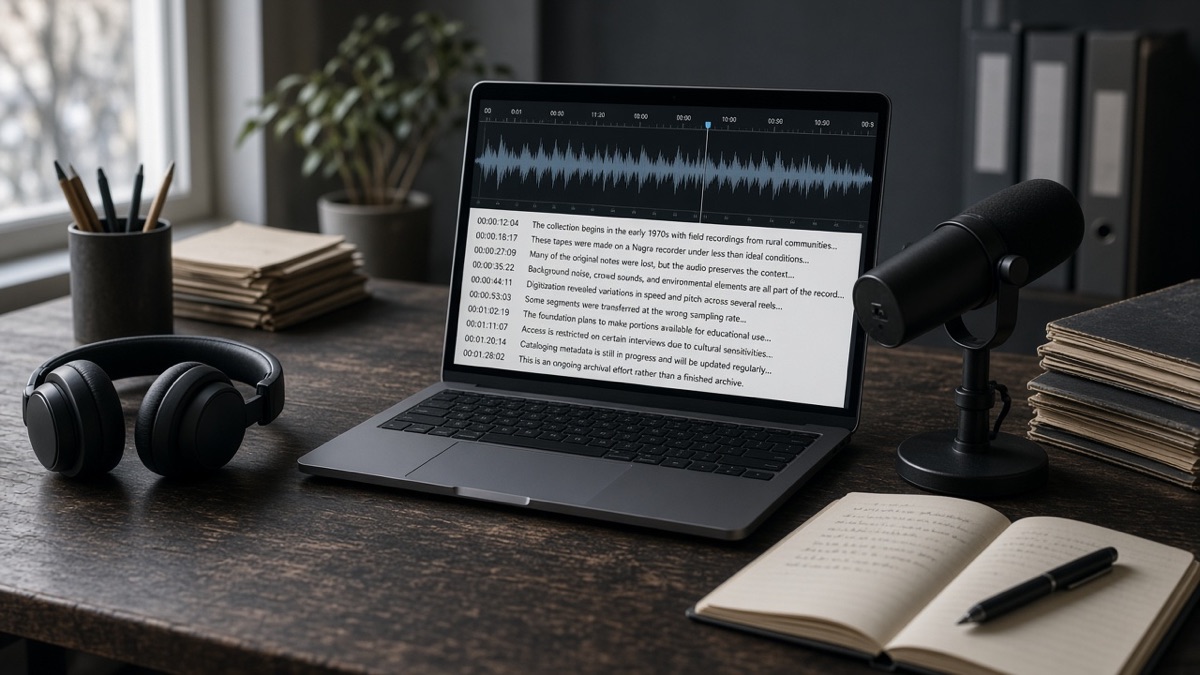
Verdict: MAI-Transcribe-2 wins archived-audio speed. Muse Voice Transcribe wins time-to-text while someone is still speaking.
Which handles speakers better?
Muse Voice Transcribe wins live speaker labeling. MAI-Transcribe-2 wins if you only need diarization after the recording is done.
Speaker diarization is new in the MAI-Transcribe-2 generation. Microsoft's 1.5 model did not offer it. Azure's MAI-Transcribe docs let you set diarization.enabled to true on Fast Transcription. That is the right shape for call-center archives, captions, and clinical notes you process after the visit.
Meta built diarization into the same streaming model as ASR and endpointing. No extra post-processing pass is required. The research blog demonstrates eight live speakers, and the product claim is 20+ speakers on audio longer than one hour. VentureBeat reports an average 17.5% diarization error rate across AMI-IHM, AMI-SDM, and VoxConverse on the chart Meta published. The Meta Model API exposes DIARIZATION and ENDPOINTING modes beside push-to-talk, which is what a voice agent actually needs: know who spoke, and know when they stopped.
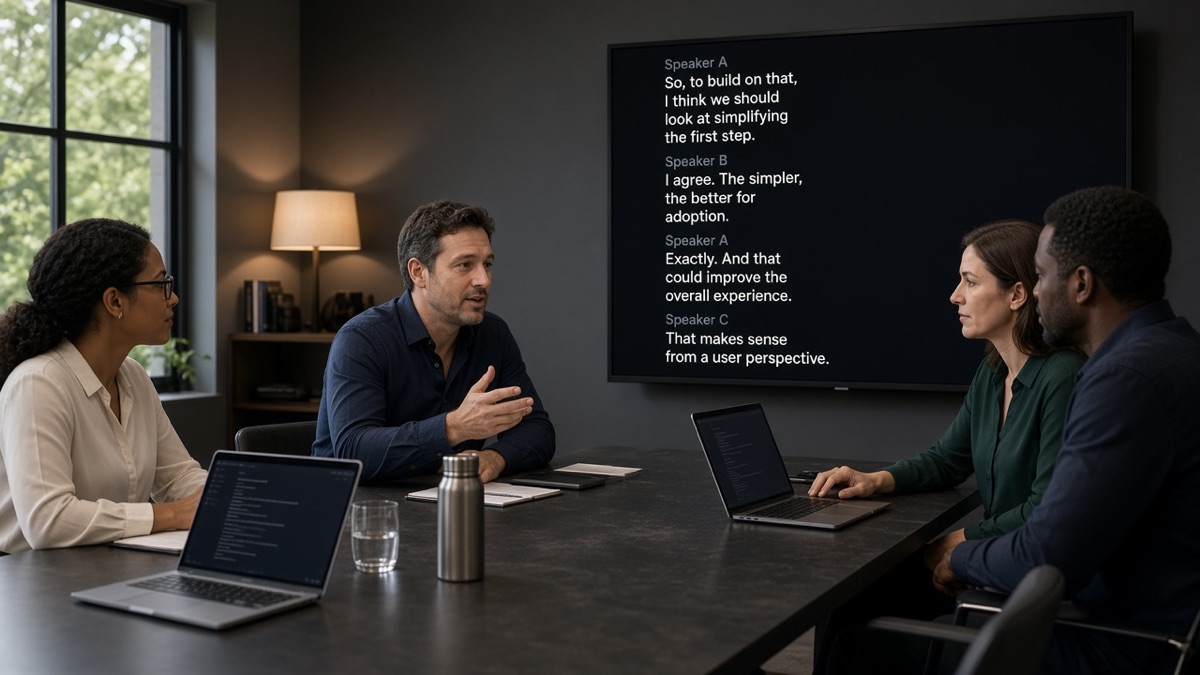
If your job is meeting transcription or speaker diarization while the conversation is still moving, streaming labels are the product. If your job is a finished Zoom export, Azure diarization on MAI-Transcribe-2 is enough and cheaper.
Verdict: Muse Voice Transcribe for live, multi-speaker rooms. MAI-Transcribe-2 for file-based speaker attribution.
Which covers more languages?
MAI-Transcribe-2 wins on counted language coverage. Muse Voice Transcribe wins on the bilingual speech Meta actually demoed.
Azure lists 60 locales for MAI-Transcribe-2, up from 43 in 1.5, including Chinese (zh) and Cantonese (yue). Automatic language identification is the default. Microsoft also calls out code-switching for pairs such as Hinglish and Spanglish, plus keyword biasing for names and domain terms, and a clean versus verbatim style switch.
Muse Voice Transcribe was trained on 70+ languages, with 25 extensively verified at launch. Meta's own demos lean into Mandarin, English, and mid-sentence code-switching, plus keyword and context biasing. That is closer to how bilingual teams actually talk than a 60-row language table. It is also a narrower production promise: Meta tells developers to start with the 25 validated languages.

For a multilingual transcription workflow, the practical rule is: use MAI-Transcribe-2 when you must cover many locales in one batch model. Use Muse Voice Transcribe when the hard problem is mixed-language speech in a live session, and the language is in the verified set.
Verdict: MAI-Transcribe-2 for breadth. Muse Voice Transcribe for live code-switching in validated languages.
How do you actually call each model?
MAI-Transcribe-2 is an Azure Speech Fast Transcription model in public preview. Muse Voice Transcribe is a Meta-hosted streaming API plus Mac dictation.
To call MAI-Transcribe-2 you set enhancedMode.enabled to true and enhancedMode.model to MAI-Transcribe-2 on Azure Speech, API version 2025-10-15. Audio must be WAV, MP3, or FLAC and under 300 MB. Word timestamps, phrase lists, locales, and transcript style are extra fields. OpenRouter also lists microsoft/mai-transcribe-2 at $0.10 per hour via Azure. Microsoft Learn still marks the feature as public preview, with no SLA, and says it is not recommended for production workloads.
Muse Voice Transcribe is muse-voice-transcribe-1.0 on the Meta Model API. Live audio uses wss://api.meta.ai/v1/asr/realtime. Finished files use POST https://api.meta.ai/v1/asr/transcribe. No weights were released. On Mac, holding Fn dictation is already wired through Meta AI for Mac and Muse Code. That is a consumer surface Microsoft does not match with a one-click dictation story for this model.
Teams that only want readable notes, not an API integration, can skip both consoles and use a browser live transcript. That path is for capturing a conversation now, not for matching every model score in this table.
Verdict: Azure and OpenRouter for MAI-Transcribe-2 files. Meta API and Mac dictation for Muse Voice Transcribe. Preview status is a real constraint on Microsoft.
What does each one cost?
For a typical hour of audio, MAI-Transcribe-2 is $0.10 and Muse Voice Transcribe is $0.18. Microsoft says the $0.10 price is a limited-time offer through the end of 2026. MAI-Transcribe-1.5 is still listed at $0.36 per hour. Artificial Analysis normalizes MAI-Transcribe-2 to $1.67 per 1,000 minutes, which is the same $0.10 per hour. Meta's public price is $3.00 per 1,000 minutes.
Hidden costs differ. Azure means a Foundry Speech resource, preview terms, and region choice. Meta means a hosted-only API and no self-host option. Streaming also bills for audio you process live, including silence your endpointing does not cut. Batch jobs are easier to estimate because you know the file length.
On pricing for a browser tool, you are paying for a product workflow, not raw model minutes. Compare API minutes only when you are building the pipeline yourself.
For files, MAI-Transcribe-2 is the cheaper minute. For streaming APIs, Muse Voice Transcribe is still inexpensive, and that minute includes diarization and endpointing.
Who should choose what?
If the audio is already a file, choose MAI-Transcribe-2. If the conversation is happening now, choose Muse Voice Transcribe.
Caption and archive teams. Choose MAI-Transcribe-2. Word-level timestamps, clean/verbatim style, 60-language coverage, and $0.10 per hour are the batch stack.
Voice-agent and dictation teams. Choose Muse Voice Transcribe. Endpointing, adaptive delay, and a WebSocket API are the live stack. Mac users who only need dictation can stay inside Meta AI for Mac.
Interviewers and meeting notes. Try interview transcription or meeting transcription in the browser first. You get a readable draft while people talk, then export TXT. Use Azure later if you need a cheaper archive pass on the recording.
Neither fits. You need on-device or open weights. Meta did not release Muse weights. MAI-Transcribe-2 is hosted Azure. Look at open ASR only if lock-in or air-gap is the constraint.
Start a live transcript in the browser if the goal is notes from a conversation happening now, without standing up Azure Speech or the Meta Model API.
Frequently asked questions
Is MAI-Transcribe-2 better than Muse Voice Transcribe?
Not across the board. MAI-Transcribe-2 is the stronger batch model on price, multilingual coverage, and non-streaming AA-WER. Muse Voice Transcribe is the stronger live model on streaming WER, speaker count, and endpointing. Match the model to batch versus live work.
Is mal-transcribe-2 the same as MAI-Transcribe-2?
Yes. Mal-transcribe-2 is the spelling people type when they hear "MAI." The product name is MAI-Transcribe-2, from Microsoft AI. There is no separate Mal Transcribe model in the Azure or OpenRouter catalogs as of 4 September 2026.
Can I use both in one product?
Yes. A common pattern is Muse Voice Transcribe (or another streaming ASR) for the live draft, then MAI-Transcribe-2 on the saved file for a cheaper, timestamped archive. That costs two API calls. It avoids forcing one model to do both jobs poorly.
Can I self-host either model?
No public weights are available for either launch. Muse Voice Transcribe is API-only. MAI-Transcribe-2 runs on Azure Speech, Microsoft Foundry, the MAI Playground, and OpenRouter.
Is MAI-Transcribe-2 production-ready in September 2026?
Treat it as preview. Microsoft Learn says the Fast Transcription enhanced-mode path is a public preview without an SLA. Muse Voice Transcribe is already powering Mac dictation and a public developer API. Preview status should weigh as heavily as WER if you are writing a customer SLA.
Verdict
| Category | Winner |
|---|---|
| Batch accuracy (AA-WER) | MAI-Transcribe-2 |
| Streaming accuracy | Muse Voice Transcribe |
| File throughput | MAI-Transcribe-2 |
| Live delay and endpointing | Muse Voice Transcribe |
| Language breadth | MAI-Transcribe-2 |
| Live multi-speaker labels | Muse Voice Transcribe |
| API price per hour | MAI-Transcribe-2 |
| Overall | MAI-Transcribe-2 for files. Muse Voice Transcribe for live speech. |
Choose MAI-Transcribe-2 when you have recordings to process. Choose Muse Voice Transcribe when you need words, speakers, and turn boundaries while people are still talking. For a no-setup check of the live path, open the prepared demo or start a live transcript. Related pages: speaker diarization and multilingual transcription.